Explore the relationship between poetry and the map, between place and language, and learn how physical location, and geographic navigation, can affect your poetics and even your sense of identity.
Poetry mapping is evolving rapidly by merging literary geography and the geopolitical with digital tools and spatial textual awareness. It is nuanced by an uncertain world where names on maps can be erased.
This course will provide opportunities to write different types of poems around poetry mapping, defined as the connections between words and physical space, visual diagrams and structural analysis, and the various historical poetic approaches employed by poets These approaches range from a literal map, as in Michael Drayton’s Poly-Olbion (1612, 1622), to an open tool for thinking or navigating inner (mind) or outer (matter) worlds. These approaches sometimes overlap or are being stretched whether vertically or horizontally and can be blurred as they map both interiors of self and exteriors of the world of things. Poetry mapping occurs within the poem and the reader and is therefore not one-dimensional.
Students will be able to understand the development of the field by exploring the contrasting approaches of William Wordsworth, John Clare, T.S. Eliot and William Carlos Williams, and the multilayered approaches of Jorie Graham and Peter Riley. There will be a nod to the different epistemological approaches of Seamus Heaney and John Ashbery.
An alternative to inner and outer mapping is viewed through the philosophy of Scottish poet, Kenneth White with his land, labour and settlement approach echoed in the hybrid writing of W.G. Sebald, Lisa Samuels and the poetry of Edward Dorn. The mapping of concrete and visual poetry will be examined with reference to Philip Metres and Lena Khalaf Tuffaha and in relation to the poet in exile and in response to war atrocities. This twentieth century approach, often in response to absence and loss, views the possibility of mapping in yet another way and allows students to gain another writing technique.
5 fortnightly sessions over 10 weeks, starting 11 February 2027. Suitable for UK & International students.
11 Feb – Course start & Assignment 1 set
18 Feb – Assignment 1 submission
25 Feb – Assignment 1 feedback deadline & Assignment 2 set
4 Mar – Assignment 2 submission
11 Mar – Assignment 2 feedback deadline & Assignment 3 set
18 Mar – Assignment 3 submission
25 Mar – Assignment 3 feedback deadline & Assignment 4 set
1 Apr – Assignment 4 submission
8 Apr – Assignment 4 feedback deadline & Assignment 5 set
15 Apr – Assignment 5 submission
22 Apr – Assignment 5 feedback deadline & course end
To apply for a concession rate, please send relevant documentation showing your eligibility for one of our concessions to administration@poetryschool.com. Conditions of eligibility are detailed here. If you have any questions or wish to be added to the waiting list of a sold-out course, please email administration@poetryschool.com.
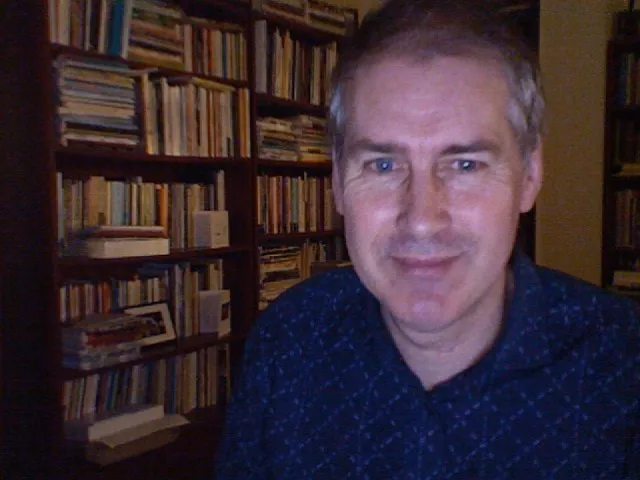
David Caddy is a writer, critic, editor, and poetry mentor. He has published books of poetry, essays, and travel writing. He has edited the international literary journal, Tears in the Fence since 1984. He has directed the annual Tears in the Fence Festival since 2011. His latest book is Interiors and Other Poems (Shearsman Books, 2023). He leads a regular poetry workshop in person and online, and has given readings, talks and workshops internationally since 1994.
£160.00
£160.00
Please note: that you will always be required to provide proof of eligibility for our concessionary rates every time you book a course with us. Concessions do not apply to our one-to-one programme.
Students & Low Income – 20% off
If you’re a full or part-time student, or receive Jobseekers Allowance, Income Support, Working Tax Credit, Universal Credit, Council Tax Support, Pension Credit, or Housing Benefit, you are eligible for 20% off our standard course fee.
If you are of pensionable age and whose sole source of income is the state pension, and you are not currently claiming income support of any kind, then we encourage you to apply for a bursary (below).
Under 30 – 50% off
Anyone under 30 years of age is eligible for 50% off. Proof of age (passport, driver’s licence, ID card) is required.
Disabled & Carers – 50% off
Anyone in receipt of Carer’s Allowance, Personal Independence Payments, income-related ESA, Enhanced Universal Credit, Attendance Allowance or Disability Living Allowance is eligible for 50% off.
If you are currently an unpaid carer and not on the Carer’s Register or claiming Carer’s Allowance, we encourage you to apply for a bursary (below).
If you have a disability (for guidance, please see the 2010 Equality Act) but you do not or cannot claim disability benefits, we encourage you to apply for a bursary (below).
Summer
School 2027
This programme of half-day workshops has been curated in collaboration with the exhibition A Fine Day for Seeing at Southwark Park Galleries.