Brave the haunted house in your writing, as we unlock the classic horror trope in this Studio course.
“I am like a small creature swallowed whole by a monster, she thought, and the monster feels my tiny little movements inside.” – Shirley Jackson, The Haunting of Hill House
“Art – a house that tries to be haunted.” Emily Dickinson
The haunted house has been a mainstay of cultures throughout the world, from literature to urban legends, visual art and beyond. It is both a tangible place with Gothic leanings and a metaphor for exploring fears of the unknown. It is also a way to express the loss of control over one’s domestic environment, and a manifestation of psychological and historical trauma.
The haunted house is a building built wrong that harbours evil intent, such as Jackson’s Hill House. It is Amityville with its true crime history imprinted in its walls. It is Eel Marsh house with its named spectre, The Woman in Black. And it’s that place you walked into that bright August morning, when every fibre of your being urged you to run, run far away – and no amount of rational thought or wild horses would drag you back there, nevermore.
And if a house is haunted, we need to ask what haunts it? A supernatural being that will not or cannot leave; or perhaps a memory that howls around your skull at 3am? In this studio we will stalk the corridors of this trope to explore where those noises are coming from. We will consider writing as exorcism and our poems themselves, as haunted houses.
Some of our presiding spirits will be Margaret Atwood, Esther Morgan, Shirley Jackson, Daphne du Maurier, Charlotte Perkins Gilman, WS Graham, Charles Simic, Chase Twichell, Clare Shaw, Matthew Sweeney, and Emily Dickinson.
30 March – Course start & Assignment 1 set
6 April – Assignment 1 submission & Assignment 2 set
13 April – Assignment 1 feedback deadline; Assignment 2 submission; Assigment 3 set
20 April – Assignment 2 feedback deadline & Assignment 3 submission
27 April – Assignment 3 feedback deadline & course end
To apply for a concession rate, please send relevant documentation showing your eligibility for one of our concessions to administration@poetryschool.com. Conditions of eligibility are detailed here. If you have any questions or wish to be added to the waiting list of a sold-out course, please email administration@poetryschool.com.
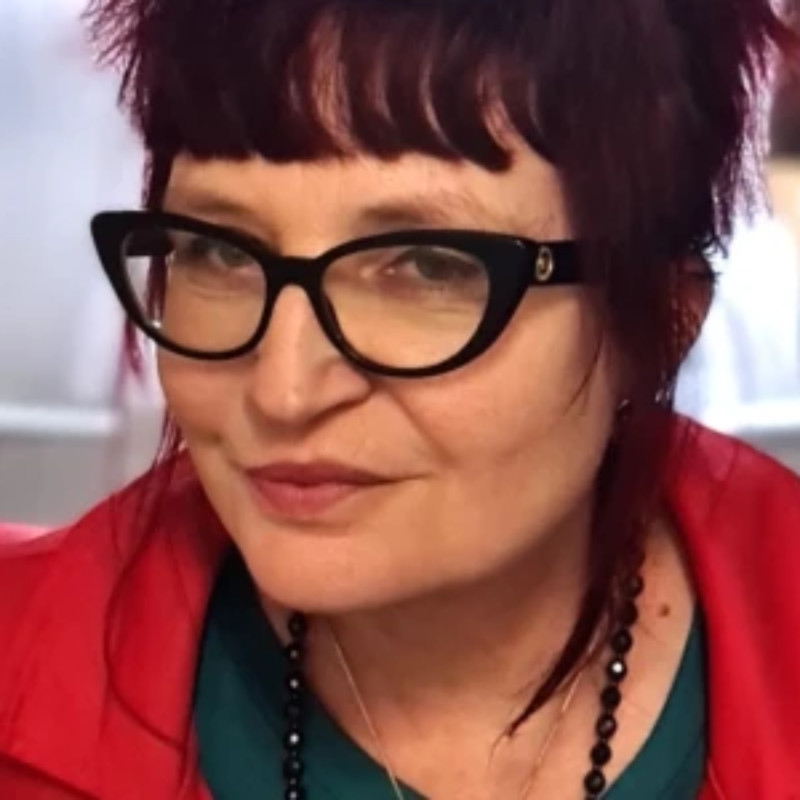
Helen Ivory is poet and visual artist who makes shadowboxes, collage, and needlefelt creatures. She has been awarded a Gregory Award and a Cholmondeley Award from the Society of Authors. She edits Ink, Sweat, and Tears and teaches and mentors for Arvon, The Poetry School, and NCW Academy. Her sixth Bloodaxe collection Constructing a Witch (2024) was a PBS Winter Recommendation and has been translated into Greek and published by Thraka. She also has work translated into Polish, Ukrainian, Croatian, Spanish, and, as part of the Versopolis European poetry platform. A poem from her surrealist chapbook Maps of the Abandoned City (SurVision 2019), is one of the Poems on the (London) Underground. Her Wunderkammer: New and Selected Poems appeared from MadHat in the US in 2023. She has just been awarded an Author’s Foundation Grant to work on her new collection for Bloodaxe.
£118.00
£118.00
Please note: that you will always be required to provide proof of eligibility for our concessionary rates every time you book a course with us. Concessions do not apply to our one-to-one programme.
Students & Low Income – 20% off
If you’re a full or part-time student, or receive Jobseekers Allowance, Income Support, Working Tax Credit, Universal Credit, Council Tax Support, Pension Credit, or Housing Benefit, you are eligible for 20% off our standard course fee.
If you are of pensionable age and whose sole source of income is the state pension, and you are not currently claiming income support of any kind, then we encourage you to apply for a bursary (below).
Under 30 – 50% off
Anyone under 30 years of age is eligible for 50% off. Proof of age (passport, driver’s licence, ID card) is required.
Disabled & Carers – 50% off
Anyone in receipt of Carer’s Allowance, Personal Independence Payments, income-related ESA, Enhanced Universal Credit, Attendance Allowance or Disability Living Allowance is eligible for 50% off.
If you are currently an unpaid carer and not on the Carer’s Register or claiming Carer’s Allowance, we encourage you to apply for a bursary (below).
If you have a disability (for guidance, please see the 2010 Equality Act) but you do not or cannot claim disability benefits, we encourage you to apply for a bursary (below).
Summer
School 2027
This programme of half-day workshops has been curated in collaboration with the exhibition A Fine Day for Seeing at Southwark Park Galleries.