Explore what becomes possible when we unlearn the expectation of finitude and instead approach incompletion as a writing method in its own right, rather than a failure to make sense.
“…ultimately I see the whole body of work as existing all but untitled and without beginning or end, an explosion of parts, the quotidian smeared.” – Fanny Howe
We will work with poems that are intentionally unfinished, uncertain, porous, contradictory, undisciplined, and, mostly, unresolved, making space for what happens when a piece is allowed to remain in process rather than settle into a stable form.
Drawing from an engagement with fragmentation, the course turns toward what emerges when language does not, or cannot, fully arrive: the gap, the pause, the omission, the erasure, the rewording, and the silenced word. How can negative space be read not as an absence of meaning, but as a mode of meaning-making?
Through experimental writing prompts and encounters with practices that disrupt demands for closure and containment, including those of Fanny Howe, Bernadette Mayer, M. NourbeSe Philip, and Forugh Farrokhzad, we will consider interruption, found language, blank space, and discontinuity. We will test forms that withhold resolution and compositions that refuse to consolidate into a prescribed shape. We will listen for what slips away, breaks apart, remains provisional, turning away from the urge to utter the final word.
The course understands the poem as a space of negotiation between the legible and the unspeakable, between fullness and vacancy, where the unsaid is something the writing actively produces—a way of resisting the impulse to fix and domesticate.
Working with texts that remain unbounded, we will treat opacity and unnaming as practices in themselves. We will attend to what language might become when we loosen our attachment to the concluded poem and relinquish the demand to get it right. An invitation, ultimately, to allow the thought to exceed its articulation.
23 Feb – Course start & Assignment 1 set
2 March – Assignment 1 submission & Assignment 2 set
9 March – Assignment 1 feedback deadline; Assignment 2 submission; Assigment 3 set
16 March – Assignment 2 feedback deadline & Assignment 3 submission
23 March – Assignment 3 feedback deadline & course end
To apply for a concession rate, please send relevant documentation showing your eligibility for one of our concessions to administration@poetryschool.com. Conditions of eligibility are detailed here. If you have any questions or wish to be added to the waiting list of a sold-out course, please email administration@poetryschool.com.
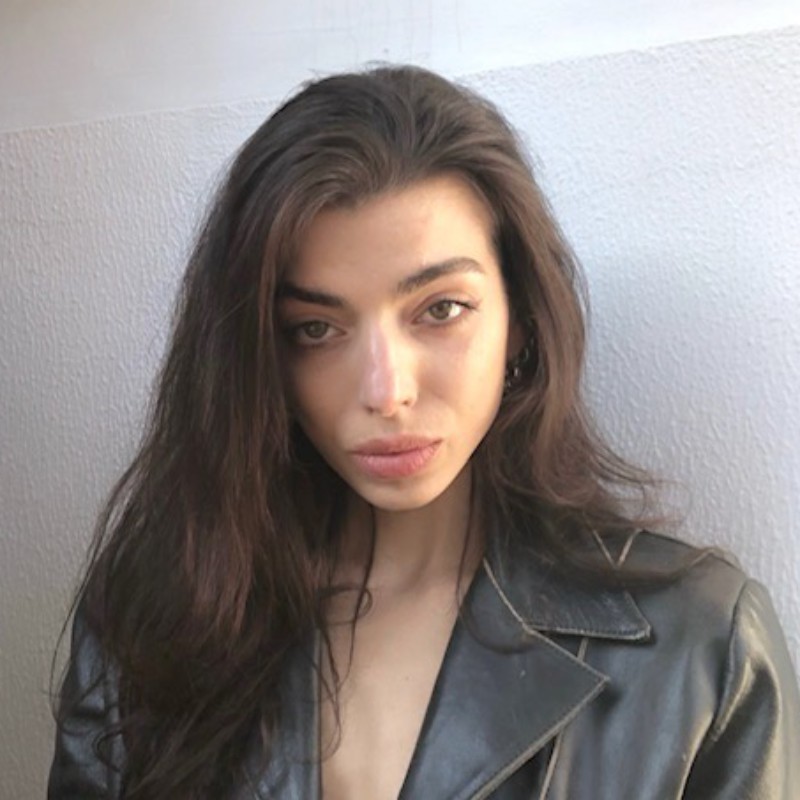
Giulia Ottavia Frattini is a poet, writer, and independent researcher based in Berlin. Her practice interweaves writing, visual culture, and critical theory, with a focus on meaning-making processes. She experiments with exophonic writing and anti-narrative forms, focusing on the tension between perception and self-determination. Her work spans poetry publications, curatorial projects, public readings, and a range of contributions – including essays, interviews, and commissioned writing – to international platforms, often engaging with hybrid forms. In 2023, she was a Visiting Teaching Artist at the Poetry Foundation in Chicago. In 2025, she joined the Poetry School as a tutor and became a lecturer at HBK – Braunschweig University of Art.
£118.00
£118.00
£118.00
Please note: that you will always be required to provide proof of eligibility for our concessionary rates every time you book a course with us. Concessions do not apply to our one-to-one programme.
Students & Low Income – 20% off
If you’re a full or part-time student, or receive Jobseekers Allowance, Income Support, Working Tax Credit, Universal Credit, Council Tax Support, Pension Credit, or Housing Benefit, you are eligible for 20% off our standard course fee.
If you are of pensionable age and whose sole source of income is the state pension, and you are not currently claiming income support of any kind, then we encourage you to apply for a bursary (below).
Under 30 – 50% off
Anyone under 30 years of age is eligible for 50% off. Proof of age (passport, driver’s licence, ID card) is required.
Disabled & Carers – 50% off
Anyone in receipt of Carer’s Allowance, Personal Independence Payments, income-related ESA, Enhanced Universal Credit, Attendance Allowance or Disability Living Allowance is eligible for 50% off.
If you are currently an unpaid carer and not on the Carer’s Register or claiming Carer’s Allowance, we encourage you to apply for a bursary (below).
If you have a disability (for guidance, please see the 2010 Equality Act) but you do not or cannot claim disability benefits, we encourage you to apply for a bursary (below).
Summer
School 2027
This programme of half-day workshops has been curated in collaboration with the exhibition A Fine Day for Seeing at Southwark Park Galleries.